Strength score & body rating
How strong are you,
really?
Lifterly reads the sets you’ve logged and gives every muscle group a strength score out of 100, against fixed benchmarks for each exercise. Add a few photos and it rates your visible muscle development too. Then it tells you, in plain words, where your next block should go.
Start for free. Build from there.
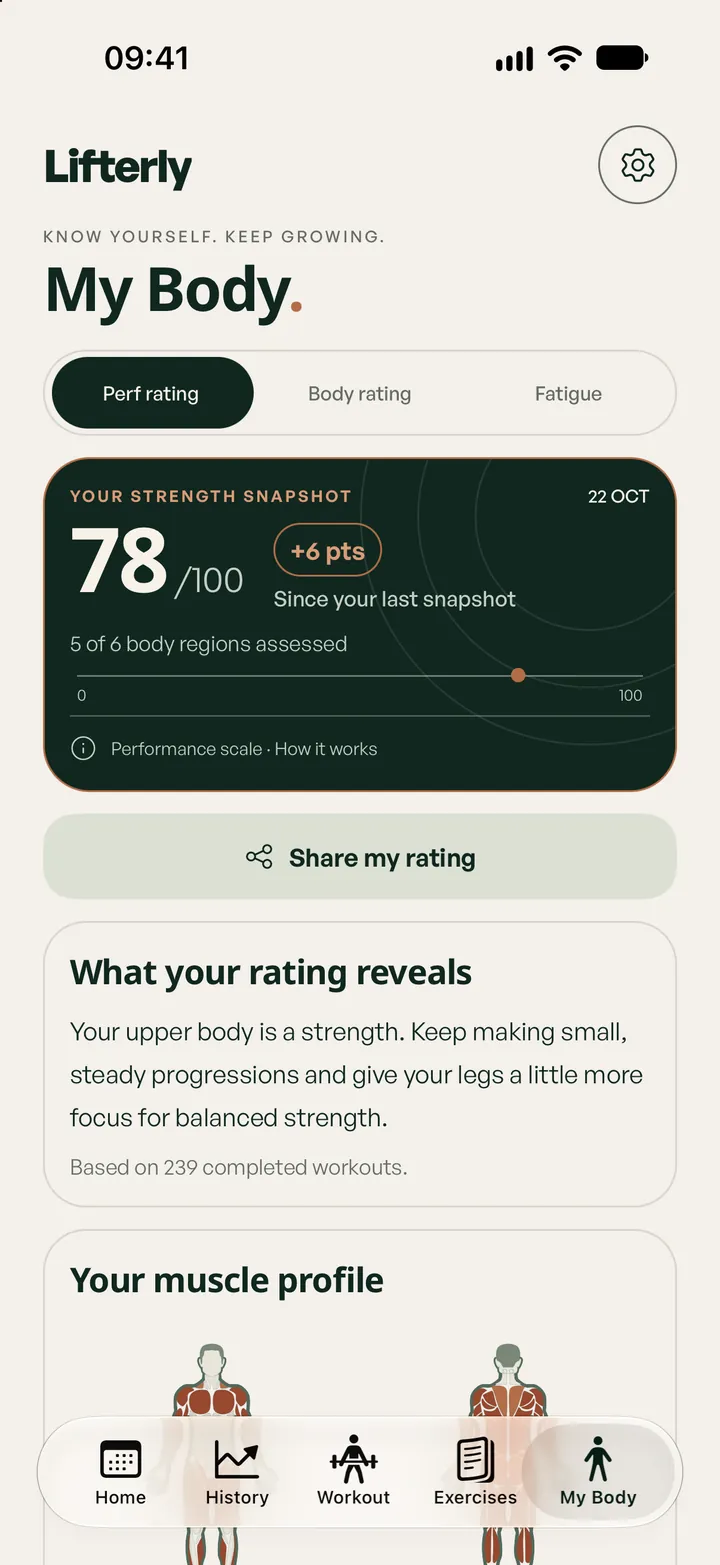
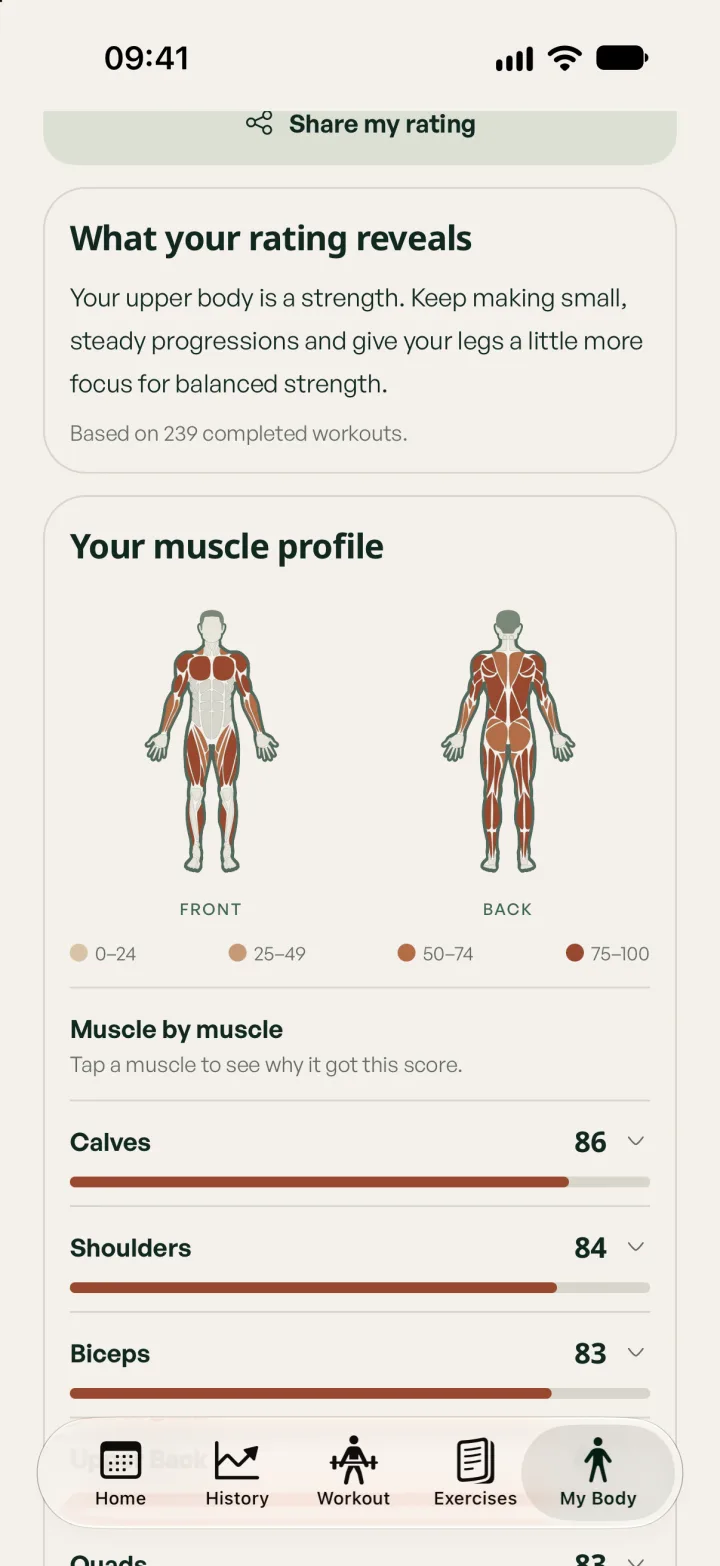
- A score for each muscle group and overall
- 0–100
- Latest workouts read for the performance rating
- 40
- Photos kept on Lifterly’s servers
- 0
How it works
Your logs in,
a clear picture out.
- 01
Log your workouts
The performance rating needs nothing else: it reads up to your last 40 completed workouts. No photos, no max-out day.
- 02
Get your scores
Each benchmarked exercise scores your best real sets, and each muscle takes the score of its exercises. Six body regions weigh equally in the overall score.
- 03
Know where to focus
Tap a muscle to see why it got its score and how sure the estimate is. A short analysis suggests what to bring up in your next block.
The performance rating
Scored from what you lifted. Never from a guess.
Each benchmarked exercise has five anchors, working loads for eight reps, that map to 20, 40, 60, 80 and 100. Your best valid set of each session is placed against them, and the median of your three latest sessions makes the exercise’s score. No one-rep max is estimated, and no hypothetical number is invented.
The scale is recreational: 20–39 beginner, 40–59 developing, 60–74 solid, 75–89 strong, 90–100 advanced. Women are compared with a reference of their own. Machines and single sessions lower the confidence, which describes how sure the estimate is, not how strong the muscle is.
The body rating
Your visible development, from a few photos.
Choose up to ten recent photos, ideally front, side and back, in fitted sportswear. Each one passes a safety check, then each visible muscle is placed on a fixed development scale, from subtle to very developed. Hidden muscles get no score; leanness, posing and lighting earn no points.
Your photos go to Lifterly’s AI provider (OpenAI) for the check and the analysis, only with your consent, and are never stored on Lifterly’s servers: copies stay on your phone. Only the rating syncs. Adults only, and it is not a health, strength or attractiveness assessment.
Over time
A reference point for every block.
Each rating is saved, so you can compare snapshots and see a muscle climb from developing to solid. The recovery map shows, front and back, which muscles your recent workouts loaded, to help you choose what to train today.
Share a card with your scores if you like: only the numbers leave the app, never the photos or the analysis.
Free and Pro
Train for free.
Get scored with Pro.
Ratings and the recovery map are part of Lifterly Pro. The workouts they read are logged for free.
Free
- Log every workout, with no limit
- Records and charts on each exercise
- Weekly volume and full history
- Apple Watch tracking
Lifterly Pro
- Performance rating, muscle by muscle
- Body rating from your photos
- Recovery map of your recent training load
- Saved snapshots to compare over time
Questions
A few things worth knowing.
How is the strength score calculated?
From your actual logged sets on benchmarked exercises: your best valid set of each session is compared with five fixed anchors (working loads for eight reps), and an exercise’s score is the median of your three latest sessions. A muscle takes the score of its exercises, and six body regions weigh equally overall.
Is it a percentile against other lifters?
No. It’s a recreational scale built from fixed benchmarks, not a ranking against other users and not a verified maximum. For a classic estimate of a single lift, use the one-rep max calculator.
Are my photos stored?
Not on Lifterly’s servers. They are sent to OpenAI for a safety check and the analysis, with your consent; copies stay on your device and are removed when you sign out. OpenAI may keep inputs under its abuse-monitoring policy. Only the rating syncs to your account.
Why does a muscle have no score?
There isn’t enough evidence yet: you haven’t logged a benchmarked exercise for it, or it isn’t visible in your photos. Missing evidence is left out rather than guessed.
Keep exploring.
- 1RM calculator
One-rep max calculator
Estimate your max from any set of up to 12 reps, with a percentage chart for your next block.
Read more - AI personal trainer
A coach that knows your training
Ask mid-workout, by voice or text: the AI coach reads your session and history, and changes the plan for you.
Read more - Workout tracker
A gym log that stays out of your way
Log sets in a tap, rest on a timer, and see every lift’s history. Free, with no limit on workouts.
Read more